Start with timing and controlled movement
Better timing in just volleyball helps you hit stronger serves, give your setter an attacking option, and rescue balls without diving past them. Start by learning when to charge, jump, and make contact. Those habits give you a foundation for powerful attacks and convincing changes of direction.
The YouTube mechanics tutorial explains several inputs that connect directly to these skills:
| Input | Reported behavior | Practical use |
|---|---|---|
| Tap E | Produces a high set | Give your attacker a higher ball to approach |
| Hold E | Adds pace to a set | Prepare a faster attack with your hitter |
| Hold Shift | Keeps facing aligned with the cursor | Maintain your orientation while positioning a block |
| Press movement keys while airborne | Tilts your character | Adjust the direction of a swing |
| Use A or D tilt while blocking | Changes your blocking coverage | Reach into the angle you expect the hitter to use |
| Right-click | Initiates a dive toward the ball's projected landing area | Reach a ball outside normal bumping range |
Practice one interaction at a time. Repeat a serve from the same starting position before changing the toss or approach, so you can identify which adjustment helped.
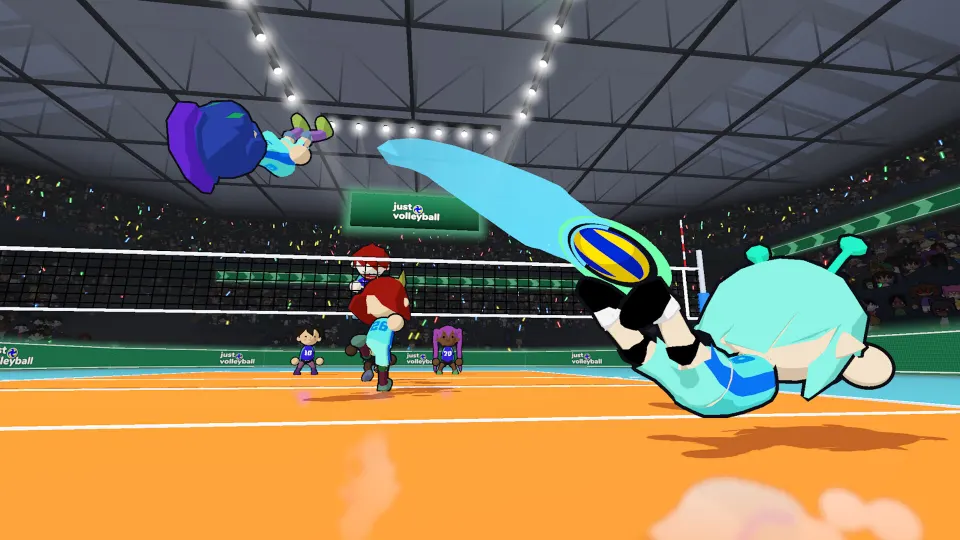
Build reliable float and power serves
Serving combines your toss, movement, jump, and contact timing. The mechanics tutorial emphasizes getting your character under the ball, while a Steam community discussion gives a specific sequence for generating stronger serves.
| Serve | Main technique | Detail to watch |
|---|---|---|
| Float serve | Tilt backward as you contact the ball | The backward tilt must coincide with impact |
| Powerful jump serve | Toss fully forward, sprint, jump, and charge your spike | Release near the highest point of your jump |
Make backward tilt part of your float serve
Both the Steam discussion and the mechanics tutorial identify backward tilt as the action behind a float serve. The tutorial specifically describes using S for that tilt.
Watch your character at contact. Tilting earlier does not mean you are still tilted backward when the swing connects. Practice until you can repeat that timing deliberately.
Give your power serve a repeatable sequence
The Steam community advice breaks down into these steps:
- Begin farther back to leave room for your approach.
- Toss the ball fully forward.
- Sprint into your jump.
- Fully charge the spike during your upward movement.
- Release around the apex, when the ball reaches your hitting position.
If the ball arrives before or after your peak, adjust the approach while keeping the toss consistent. Once you repeatedly meet the ball near the apex, experiment with placement.
The mechanics tutorial allows more flexibility in toss placement, provided you time the jump correctly. The forward toss is therefore a useful starting routine, not the only possible serving setup.
Speed up sets and disguise attacks
A quick attack depends on the setter and hitter preparing together. The Steam discussion recommends charging the set fully and aiming toward the position where the attacker will be rising. It also notes that you can build that charge while running.
Watch the attacker's approach and target their rising path rather than the position they occupy when you begin setting.
| Setting choice | Community advice | Attacker's responsibility |
|---|---|---|
| High set | Tap E, according to the mechanics tutorial | Read the flight and adjust the approach |
| Faster set | Hold E to increase pace | Be ready before the ball arrives |
| Coordinated quick | Fully charge and target the hitter's rising path, according to the Steam discussion | Match the jump to the setter's delivery |
Community advice differs on how easily fast sets can be attacked. The Steam discussion recommends fully charged quicks, while the YouTube mechanics tutorial describes difficulty swinging at its fast sets and highlights their ability to fool blockers. Practice the connection with your hitter before relying on it during a rally.
For powerful spikes, the Steam discussion recommends the same broad technique as a power serve: charge during the rise and coordinate contact near the jump's peak. Your setter controls the incoming ball, so adjust to its actual height and arrival time.
The YouTube beginner guide recommends starting a credible approach even when you are unsure whether you will receive the set. This gives the setter another option and makes opponents decide which attacker to follow.
Once your timing is dependable, add deception:
- Approach toward one direction, then aim elsewhere after jumping.
- Show one shot while airborne, then turn before releasing the swing.
- Coordinate approaches so the setter has multiple believable options.
- Keep teammates available to recover a blocked attack.
Both gameplay tutorials recommend changing your apparent hitting direction to mislead blockers. Add that turn gradually; the immediate goal is to preserve a reliable contact while making your final target harder to read.
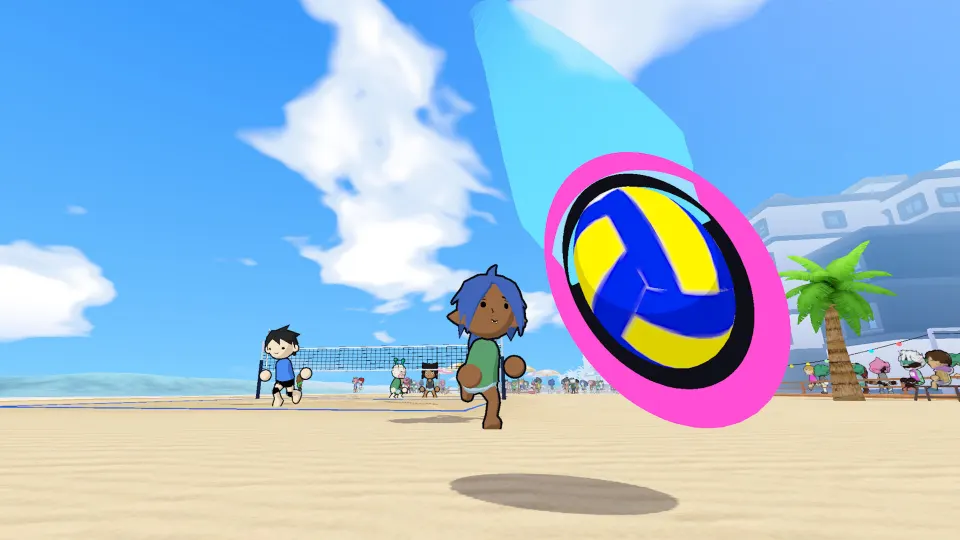
Block angles your teammates cannot cover
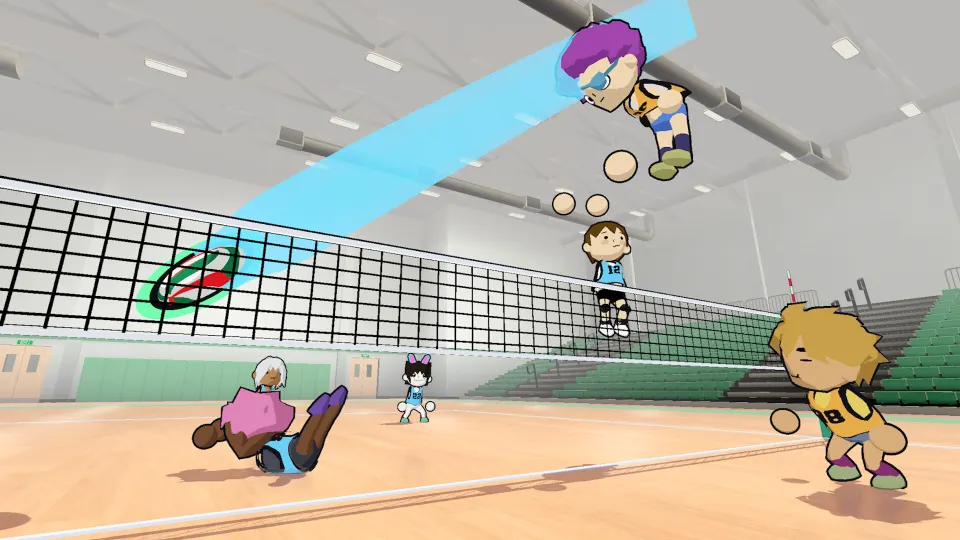
A useful block starts with reading the attack. Watch the opposing hitter's approach, position, and apparent aim, then move into the lane you expect them to use. The beginner guide stresses that good timing cannot compensate for standing outside the ball's path.
The mechanics tutorial describes holding Shift to keep your facing aligned with the cursor. That lets you adjust your position while maintaining the orientation you want toward the attacker. It also demonstrates using A or D tilt to cover an anticipated hitting angle.
Build your blocking decisions around the whole defense:
- Check which area your back-row teammate is already covering.
- Position your block against another likely attack lane.
- Follow the hitter's approach and adjust sideways as the play develops.
- Stay alert for a last-moment change in their aim.
You will sometimes get fooled by a late turn. Review whether your block covered a useful lane and whether teammates were ready to defend the remaining angle.
The beginner guide also recommends directing a successful block down close to the opposing hitter. A shorter return gives defenders less time to react, although getting into position for the contact comes first.
Exact block-break conditions have not been officially confirmed. A strong swing should not be treated as a guaranteed way to break a block; the Steam discussion raises that question without establishing a rule.
Save rallies with smarter movement and dives
Diving helps when it extends your reach. The beginner guide warns that diving for a ball already within bumping range can cause a miss or knock teammates over.
Use the ball's distance and trajectory to choose your response:
| Situation | Response to practice | Reason |
|---|---|---|
| Ball is falling within normal bumping range | Stay positioned and bump | A dive can carry you away from a manageable contact |
| Ball is just outside bumping range | Use a timed dive | The extra reach can save the rally |
| Ball is traveling beyond normal movement reach | Sprint to close the gap | Faster movement may get you into position |
| Teammates are close to your recovery path | Avoid an unnecessary dive | Diving can disrupt nearby players |
According to the mechanics tutorial, the dive follows the ball's projected landing area rather than simply following your cursor. It recommends preparing your intended receiving direction before diving. Practice distinguishing where your character needs to travel from where you want the return to go.
The beginner guide reports wasting stamina through unnecessary sprinting. Watch the play early and reserve sprinting for balls that ordinary movement cannot reach.
Recovery positioning matters during your own attacks. The beginner guide recommends keeping one or two players beneath the attacker or farther back to recover a blocked ball.
FAQ
What should beginners practice first?
Start with repeatable contact timing, basic sets, and choosing when to bump instead of dive. These just volleyball tips and tricks become more useful when you recognize why a play failed. Add faster attacks and deceptive turns once ordinary contacts feel dependable.
How do you perform a float serve?
Tilt backward when your swing contacts the ball. Both the Steam community discussion and the YouTube mechanics tutorial describe this technique; the tutorial identifies S as the backward tilt input.
Why does my fully charged serve still feel weak?
Review the whole sequence: forward toss, sprinting approach, jump, charge during the rise, and contact near the apex. The Steam recommendation combines those actions. Charging fully is only one part of that setup.
Should everyone approach for a spike?
Multiple attacking options help the setter and complicate the opposing block, but someone still needs to cover a rebound. Coordinate approaches while leaving teammates ready beneath the attack or in the back row.
Does diving always follow the cursor?
The mechanics tutorial describes dives as tracking the ball's projected landing area. Prepare your receiving direction ahead of contact, and use a normal bump when the ball is already within reach.